


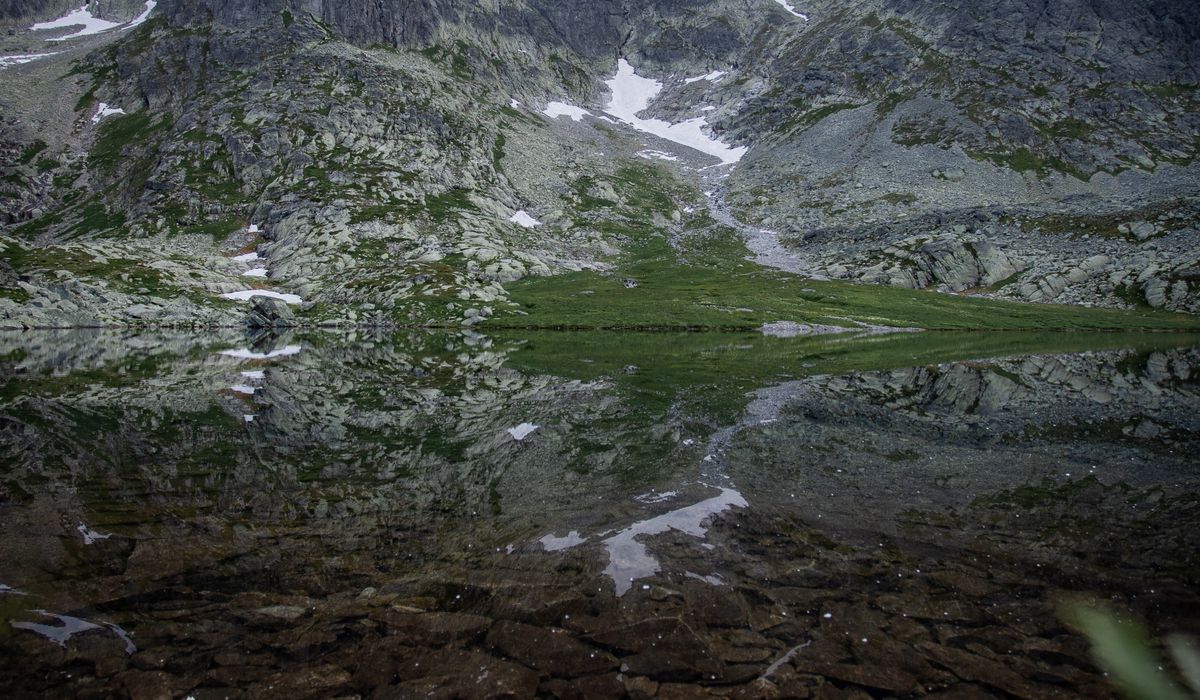
Why an early start changes everything
Mountain tarns are small, shallow and often tucked into bowls where the wind drops overnight. That stillness is brief. By mid-morning, the sun has climbed, the breeze has picked up and the perfect mirror has broken into ripples. Arriving 45–60 minutes before sunrise gives you time to walk in by headtorch, find a safe pitch and watch the light build. In the UK, that might mean a pre-dawn ascent in Eryri, a boggy traverse in the Lake District or a long approach across the Cairngorms plateau. The reward is not just reflection; it is soft, low-contrast light that reveals texture in rocks, moss, reeds and peat.
The best mornings often follow a clear, cold night, when mist gathers over the water and first light turns it pink and gold. Check the mountain weather forecast, but also trust your eyes. Either way, the tarn itself is the subject. Its edges, islands and outflow streams give you foreground detail that a grand vista alone cannot.
Plan the walk, not just the shot
Upland walking in the dark is slower than you think. A route that takes two hours in daylight can take three before sunrise, especially with camera kit. Study the map, note handrails and obvious paths, and set a turnaround time. Tell someone where you are going and when you expect to be back.
- Pack for the conditions: waterproof jacket and trousers, insulating layer, hat, gloves, spare socks, emergency shelter, headtorch with fresh batteries.
- Navigation: map, compass, GPS or phone with offline maps, plus a power bank. Do not rely on a signal.
- Footwear: stiff-soled boots with good grip. Tarn edges are often boggy, rocky and slippery.
- Timing: aim to be at the tarn 30–45 minutes before sunrise. Use the blue hour to compose and focus.
If the approach is long, consider a bothy or a wild camp, but check local access and camping rules first. In England and Wales, wild camping is restricted on many upland areas; in Scotland, it is more widely permitted but still subject to leave-no-trace principles.
Expose for the brightest highlights
Soft morning light is deceptively bright. A sunlit cloud, a patch of snow or the first flare on the water can clip to white and lose all texture. Expose for the brightest highlights you want to keep, then lift the shadows in post-processing. On a tripod, use ISO 100, an aperture around f/11 for depth of field, and adjust shutter speed until the histogram sits just below the right-hand edge. If the scene has more contrast than your sensor can hold, bracket three or five frames and blend later.
- Metering: use highlight-weighted or spot metering on the brightest cloud or reflection.
- Histogram: check the red channel for clipping; small specular highlights are fine, large white areas are not.
- Filters: a graduated neutral density filter can hold back a bright sky, but avoid over-darkening the tarn. A polariser can cut glare, yet it also reduces reflections, so use it sparingly.
- Stability: tripod, remote release or two-second timer, and mirror lock-up if you use a DSLR. Hang your bag from the centre column in wind.
Shoot raw. Morning colour temperature shifts quickly, and raw gives you room to correct white balance and recover shadow detail.
Compose for reflection and foreground
Mountain tarns are rarely about the water alone. Look for a foreground anchor: a half-submerged boulder, a curve of pebbles, a tuft of cotton grass, or an outflow stream leading the eye in. Get low and close with a wide-angle lens, but keep the horizon level. A reflection doubles the mountain, so decide whether you want symmetry or a more dynamic diagonal. Portrait orientation often suits tarns because it emphasises foreground and sky together.
Focus carefully. At f/11, focus roughly one-third into the scene, or use hyperfocal distance if you know it. Check the corners of the frame at 100% on the back screen. If the wind is rippling the water, a slightly longer exposure can smooth it, but do not lose the texture of the foreground. Sometimes a small ripple is better than a perfect mirror; it adds life.
Kit, fieldcraft and safety
You do not need a huge pack, but a few items earn their place on an upland morning.
- Tripod: light enough to carry, sturdy enough for a breeze. Carbon fibre lighter; aluminium cheaper.
- Lens cloth: mist, rain and spray are companions. Carry two and keep one dry.
- Lens hood: shields against stray light and rain.
- Spare battery: cold drains batteries fast. Keep it in an inside pocket.
- Sit mat or knee pads: tarn edges are wet and rocky; dry knees make you patient.
Move quietly and slowly. Upland birds and mammals are easily disturbed, especially in spring and summer. Stay on established paths where possible, avoid trampling fragile moss and vegetation, and never leave litter or food scraps. Close gates and keep dogs under control.
Before you leave, check the forecast. Conditions on the tops can differ from the valley. Turn back if the wind, rain or cloud becomes unsafe. A photograph is never worth a risky descent. Walk within your ability, carry the right kit, and leave the uplands as you found them. Then, when the light does arrive, you will be ready: tripod set, composition chosen, highlights protected and foreground sharp. That is how a mountain tarn becomes a textured portrait of a British upland morning.


Leave a reply